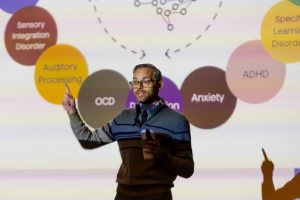
 Earlier this year, I had the opportunity to visit Randolph College (Lynchburg, VA) for its annual Student Success Summit, where faculty and staff came together to explore how colleges can better support neurodivergent students. Much of our conversation centered on a reality that schools and colleges across the country are increasingly experiencing: students are arriving with more complex learning profiles, and the systems surrounding them must continue to evolve in response. Supporting neurodivergent students cannot simply mean adding more resources around the edges of an institution. It requires us to think more intentionally about the institution itself.
This week, I am returning to Randolph College as part of a new two-year partnership between Randolph, the Center for Neurodiversity, and me to advance the Randolph Inclusive Learning Initiative. The partnership is focused on embedding neuroinclusivity more intentionally throughout the College and strengthening access, persistence, and post-graduate success for students with complex learning profiles. What makes this work especially meaningful is that Randolph is approaching neuroinclusion not as the responsibility of one department, but as an institutional commitment.
Over the next two academic years, the work will touch many aspects of the student experience. Together, we will examine current systems and potential structural barriers, collaborate with faculty through the lens of Universal Design for Learning, develop faculty learning communities, consider admissions and enrollment practices, provide professional development for faculty, staff, and leadership, and explore ways to engage families while continuing to promote student autonomy. These areas may appear distinct, but they are deeply connected. A student’s experience of college is shaped not only by what happens in the classroom, but also by how they enter the institution, how expectations are communicated, how relationships are built, how support is accessed, and how independence is developed over time.
My visit this week reflects that broad approach. I will spend time with leaders in enrollment, academic affairs, student life, and the president’s office, while also visiting classes in nutrition and fitness, sociology, and psychology. Conversations will examine onboarding and the transition into college, orientation, inclusion and access, student engagement, campus culture, and the overall student experience. Before meaningful recommendations can be made, it is important to understand how students actually experience an institution and where there may be opportunities to make that experience more accessible, intentional, and responsive.
This is a concept we think about often at Franklin Academy. Our work with neurodivergent students has reinforced that support and independence are not opposing ideas. The right support helps students develop greater self-awareness, stronger executive functioning, increased confidence, and the ability to advocate for themselves. The goal is not to remove every obstacle or make every experience easier. It is to create environments in which students can practice navigating challenges, learn from setbacks, and gradually assume greater ownership of their lives.
 That same philosophy has important implications for higher education. Colleges often expect students to arrive ready for independence, but independence is developmental. It is built through experience, feedback, practice, and opportunity. When institutions think carefully about the systems surrounding students, they can maintain meaningful expectations while also reducing unnecessary barriers that interfere with learning, participation, and growth.
The question, then, is not simply how we help neurodivergent students succeed within existing systems. It is also whether those systems are designed to support the range of students now entering our schools and colleges. Randolph College is taking that question seriously, and I am grateful for the opportunity to participate in the work ahead.
For the Center for Neurodiversity, this partnership also represents an important part of its broader purpose. In addition to direct work with individuals and families, the Center can help schools, colleges, and other organizations examine the environments surrounding neurodivergent people and consider how those environments might become more inclusive, responsive, and effective.
I am looking forward to returning to Randolph this week and beginning this next phase of our work together. Meaningful neuroinclusion is rarely created through a single program, training, or initiative. It develops when an institution is willing to listen, examine its practices, and continue evolving in response to the people it serves.
That is the work of becoming a truly neuroinclusive community.