One of the things I have learned in working with neurodivergent students is that their experiences rarely fit neatly into separate categories.
A challenge with executive functioning may show up in the classroom, during evening routines, or in getting ready for the next day. A difficult social interaction may affect a student’s ability to engage academically. A strategy that works well in one environment may reveal something important about how that student can be supported in another.
At Franklin Academy, we believe we understand students best when we look at the whole picture.
That belief is at the heart of our Dyadic Advising Model, which pairs every student with two grade-based advisors: an Academic Advisor and a Student Life Advisor. Each advisor sees a different part of a student’s daily experience, but they work together toward the same larger goal: helping students develop greater self-awareness, confidence, self-advocacy, and independence.
The Academic Advisor may notice patterns related to coursework, planning, organization, executive functioning, academic expectations, or preparation for what comes next. The Student Life Advisor sees students navigating relationships, routines, residential life, community expectations, and the less-structured parts of the day that can often tell us just as much about how a student is doing.
Neither perspective tells the whole story on its own.
When those perspectives are connected, we can begin to see patterns across settings. A student who struggles to initiate an assignment may also have difficulty initiating a conversation with a peer. A student who independently manages an evening routine may be ready to use similar strategies to organize academic responsibilities. A student who demonstrates confidence in an activity or residential setting may have strengths that can be intentionally carried into the classroom.
Our advisors are able to look at those connections through a shared assessment model that examines student skill performance and postsecondary expectations across both academic and student life domains. Having that common framework matters. It gives us a consistent language for recognizing strengths, identifying areas of growth, and asking an important question: Is the student able to use this skill across different settings?
For neurodivergent learners, that transfer of skills can be especially important. Knowing how to do something in one environment does not always mean that a student can automatically apply it somewhere else. Part of our work is helping students recognize those connections and practice using strategies in different contexts.
But the purpose of dyadic advising is not to surround students with more adults who solve problems for them. It is almost the opposite.
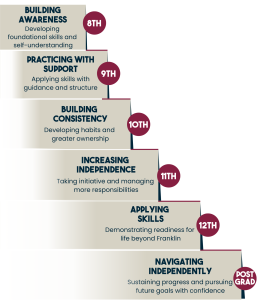
Early on, an advisor may help a student recognize a challenge, name a pattern, or identify possible next steps. Over time, our goal is for the student to take on more of that work themselves: noticing the pattern first, initiating the conversation, explaining what they need, considering possible solutions, and deciding when and how to seek support.
That progression matters because independence does not mean never needing help.
For our students, independence often means understanding themselves well enough to know what works, recognizing when something is not working, and having the confidence and self-advocacy skills to respond.
As Director of Student Success, I see the value of this model in the conversations that happen between advisors, but even more importantly, in the conversations students begin to have for themselves. When a student can recognize that something is difficult, identify a strategy that has worked before, or seek support before a challenge becomes larger, that represents meaningful growth.
Those are not simply school skills. They are skills students will need in college, at work, in relationships, and throughout adulthood.
At Franklin, our goal is never simply to help a student get through the challenge in front of them. We want students to better understand why the challenge exists, recognize the tools available to them, and increasingly become the person driving what happens next.
That is what our Dyadic Advising Model is ultimately designed to do: connect support across the student experience today while helping students build the self-awareness, confidence, and agency they will need long after Franklin.